Color blindness statistics
About 1 in 12 men and 1 in 200 women of Northern European ancestry have red-green color blindness, and it is less common in almost every other population studied.[1] Every number on this page links to the study or health agency it comes from. Last updated 2026-10-12.
Key figures
- 1 in 12 men, 1 in 200 women — people of Northern European ancestry.[1]
- About 8% of men and 0.4% of women — European population surveys.[3]
- 4% to 6.5% of men of Chinese and Japanese ethnicity.[3]
- 2.59% of children and teenagers worldwide (4.38% of boys, 0.64% of girls) — 56 studies, 21 countries, 1,703,619 people tested.[7]
- Deuteranomaly (weak green) is the most common type[4] — about 5% of men.[5]
- Blue-yellow (tritan) color blindness: fewer than 1 in 10,000 people, and men and women equally.[1]
- Seeing no color at all (achromatopsia): about 1 in 30,000 people.[8]
How common is color blindness?
About 8% of men and under 1% of women in populations of European ancestry. MedlinePlus Genetics (part of the U.S. National Library of Medicine) gives it as "about 1 in 12 males and 1 in 200 females" among people with Northern European ancestry.[1] The National Eye Institute states the men's half the same way: "About 1 in 12 men have color vision deficiency."[2]
Sources agree on the men's figure but differ slightly on women: MedlinePlus says 1 in 200 (0.5%), while a 2012 review of large population surveys by Jennifer Birch puts it at "about 0.4% in women".[3] Quote whichever you use with its source.
Which type of color blindness is most common?
Deuteranomaly — the green-sensing cones respond weakly, so greens look redder. The National Eye Institute calls it "the most common type of red-green color vision deficiency".[4] A standard textbook table gives these rates:[5]
| Type | Men | Women |
|---|---|---|
| Deuteranomaly (weak green) | 5% | 0.4% |
| Deuteranopia (no green) | 1.5% | 0.01% |
| Protanomaly (weak red) | 1% | 0.01% |
| Protanopia (no red) | 1% | 0.01% |
| Tritanopia (no blue) | 0.008% | 0.008% |
| All types | about 8% | about 0.5% |
These are long-standing estimates (after Cole 1972, Pease 1998 and Wright 1952), not one new survey. In a 2014 study of preschool boys, 51% of cases were deutan (green) and 34% protan (red).[6] Rarer forms: blue-yellow (tritan) defects affect "fewer than 1 in 10,000 people worldwide", blue cone monochromacy about 1 in 100,000,[1] and achromatopsia, where a person sees no color, "approximately 1 in 30,000 people worldwide".[8]
Is color blindness more common in some ancestries?
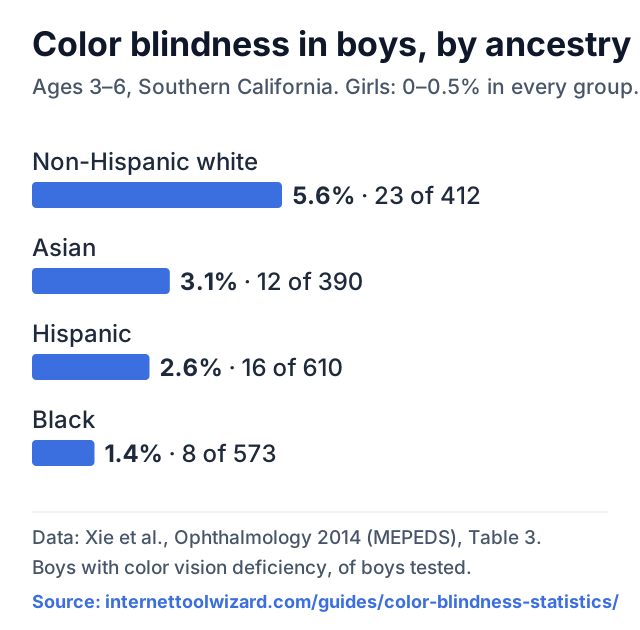
Yes. The Multi-Ethnic Pediatric Eye Disease Study tested children aged 3 to 6 in Southern California and found the highest rate in non-Hispanic white boys and the lowest in Black boys.[6]
| Ancestry | Boys | Girls |
|---|---|---|
| Non-Hispanic white | 5.6% (23 of 412) | 0.0% (0 of 359) |
| Asian | 3.1% (12 of 390) | 0.5% (2 of 378) |
| Hispanic | 2.6% (16 of 610) | 0.2% (1 of 631) |
| Black | 1.4% (8 of 573) | 0.2% (1 of 652) |
Percentages are worked out from the study's own case counts (its Table 3, ages 3 to 6) and match the rates it reports. These are young children, so the authors note the adult figures in earlier studies are higher — "consistently 6% or higher" in groups such as European whites.[6]
Other studies point the same way for East Asia — "between 4% and 6.5% in men of Chinese and Japanese ethnicity"[3] — but not everywhere: a 2025 worldwide review of children found almost the same rate in people of European descent (2.77%) and African descent (2.69%).[7] Birch's review reports that "Recent surveys suggest that the prevalence is rising in men of African ethnicity" and proposes that the differences come from founder effects and genetic drift.[3]
Color blindness in other countries
School screening studies, each with its own test and age group — so compare them with care:
| Where, who was tested | Overall | Boys | Girls |
|---|---|---|---|
| India (Uttarakhand) [10] 13,492 schoolchildren, 6–16 | 2.2% | 3.0% | 1.4% |
| China [11] 2,849 first-graders | 1.68% | 2.81% | 0.16% |
| Iran [12] 2,160 primary-school children | 2.2% | 3.5% | 1.0% |
| 21 countries (review) [7] 1,703,619 children and teens | 2.59% | 4.38% | 0.64% |
How many people in the world are color blind?
Nobody publishes a measured worldwide count. We checked the National Eye Institute, MedlinePlus, the NHS, the World Health Organization and the review papers above, and none gives one. The widely repeated "300 million" figure has no primary source we could trace. Multiplying the European 8% by the world's population would overstate it, because rates are lower in most other groups.[1]
How many color-blind people don't know it?
No national figure exists. The National Eye Institute says only that symptoms are often mild, and "that's why many people with color vision deficiency don't know they have it."[2]
Why is color blindness more common in men?
The genes for red and green light sensors, OPN1LW and OPN1MW, sit on the X chromosome, and red-green color blindness is inherited in an "X-linked recessive pattern".[1] Men have one X chromosome, so one changed copy is enough. Women have two, so both must carry the change — which is rare.[2] Blue-yellow color blindness is different: its gene, OPN1SW, is on chromosome 7,[9] one changed copy is enough, and it affects men and women equally.[1]
What this means if you make charts, slides or websites
In a room of 25 men of European ancestry, about two are likely to have red-green color blindness. Three habits help them most:
- Never use color alone to carry meaning. Add a label, icon, pattern or underline.
- Keep strong light-dark contrast between text and background — check any pair with our free color contrast checker.
- Avoid red-versus-green for things people must tell apart, such as chart lines or pass/fail states. Pick colors with the color picker and check them before you publish.
Cite this page
Internet Tool Wizard. (2026). Color blindness statistics: how common is it? Retrieved from
https://www.internettoolwizard.com/guides/color-blindness-statistics/
For a single figure, please cite the original source listed below.
Sources
- MedlinePlus Genetics (U.S. National Library of Medicine). Color vision deficiency.
- National Eye Institute (NIH). Color Blindness.
- Birch J. Worldwide prevalence of red-green color deficiency. J Opt Soc Am A. 2012;29(3):313–320. doi:10.1364/JOSAA.29.000313
- National Eye Institute (NIH). Types of Color Blindness.
- Kalloniatis M, Luu C. Color Perception, Table 1 "Prevalence of congenital colour deficiencies" (after Cole 1972, Pease 1998, Wright 1952). Webvision: The Organization of the Retina and Visual System.
- Xie JZ, Tarczy-Hornoch K, Lin J, et al. Color vision deficiency in preschool children: the Multi-Ethnic Pediatric Eye Disease Study. Ophthalmology. 2014;121(7):1469–1474. doi:10.1016/j.ophtha.2014.01.018
- Jeong YD, et al. Global Prevalence of Congenital Color Vision Deficiency among Children and Adolescents, 1932–2022. Ophthalmology. 2025;132(12):1431–1444. doi:10.1016/j.ophtha.2025.07.031
- MedlinePlus Genetics (U.S. National Library of Medicine). Achromatopsia.
- MedlinePlus Genetics (U.S. National Library of Medicine). OPN1SW gene.
- Mittal SK, et al. Burden of ocular morbidities and color blindness among school-attending children in a foothill town of Uttarakhand State. Indian J Ophthalmol. 2022;70(1):249–255. doi:10.4103/ijo.IJO_1677_21
- Gan J, Li SM, Atchison DA, et al. Association Between Color Vision Deficiency and Myopia in Chinese Children Over a Five-Year Period. Invest Ophthalmol Vis Sci. 2022;63(2):2. doi:10.1167/iovs.63.2.2
- Rajavi Z, et al. Prevalence of color vision deficiency and its correlation with amblyopia and refractive errors among primary school children. J Ophthalmic Vis Res. 2015;10(2):130–138. doi:10.4103/2008-322X.163778
Questions
- What percentage of the population is color blind?
- Among people of Northern European ancestry, about 1 in 12 men (about 8%) and 1 in 200 women (0.5%) have red-green color vision deficiency, according to MedlinePlus Genetics. It is less common in almost every other population studied. A 2025 review of 56 studies of children and teenagers in 21 countries put the overall rate at 2.59%: 4.38% of boys and 0.64% of girls.
- Is color blindness more common in men or women?
- Men, by far. The genes for red and green color vision sit on the X chromosome. Men have one X chromosome, so one changed copy is enough. Women have two, so both copies must be changed, which is rare. That is why the usual figures are about 1 in 12 men but 1 in 200 women.
- What is the most common type of color blindness?
- Deuteranomaly, a weaker response to green light. The U.S. National Eye Institute names it the most common type of red-green color vision deficiency, and a standard textbook table puts it at about 5% of men.
- How many people in the world are color blind?
- No health agency or study we could find publishes a worldwide count. The often-repeated "300 million" figure has no traceable primary source. Rates also differ by ancestry, so multiplying the European 8% by the world population overstates it.